
This guide is intended for entry-level marketers. If you’re more experienced, you may already be familiar with many of the points below.
This guide is intended to share general observations and common practices. It is not intended as marketing advice, and results may vary depending on platform, industry, and individual campaign setup.
One difference that some clients notice when comparing basic marketing campaigns with campaigns that use Pearl Diver Intent Data is that these campaigns often benefit from more active monitoring and optimization. While they may take a little longer to set up, many teams find that this additional effort can be worthwhile over time.
Meta’s advertising system (including its AI learning model Andromeda) learns across your entire ad account. This means your Pearl Diver Intent campaigns can help improve targeting performance across your other campaigns as well.
Pearl Diver intent data is best used to run a new additional campaign, in addition to your existing marketing campaigns, not to completely replace it.
A/B Testing
A common approach in digital marketing is to remain flexible by using A/B testing.
A/B testing typically involves running multiple variations of a campaign (for example, different creatives, audiences, or settings) and comparing performance. Over time, lower-performing variations can be reduced or paused, while stronger performers can be given more focus, alongside continued experimentation.
Many teams use this process as an ongoing way to refine performance rather than aiming for a single “perfect” setup.
Campaign Goal / Target
The campaign goal selected within an advertising platform helps determine what the platform attempts to optimize for.
We generally recommend optimizing for:
-
Form submissions
-
Website conversions
Using these goals generally requires conversion tracking to be in place, often through the installation of the platform’s tracking pixel. You may also need to feed sign ups through the Meta API to attribute sign ups generated via Meta campaigns.
When a conversion is recorded, the platform receives feedback that may influence how it prioritizes contacts within the Pearl Diver Intent list (or similar contacts, if lookalike features are enabled).
Traffic-focused objectives (such as clicks or visits) may sometimes result in higher volumes but lower engagement. Testing different objectives can help determine what works best for a specific campaign.
Restricting Campaigns to Pearl Diver Intent Data
You will want to select the custom audience Pearl Diver is sending data to in the Ad Set settings under the Audience section, as per the image below.
For Meta: You should also see at the bottom a "switch to recommended setup" box if you have turned advantage+ off. If Advantage+ is on, it will instead say, "Further limit the reach of your ads".
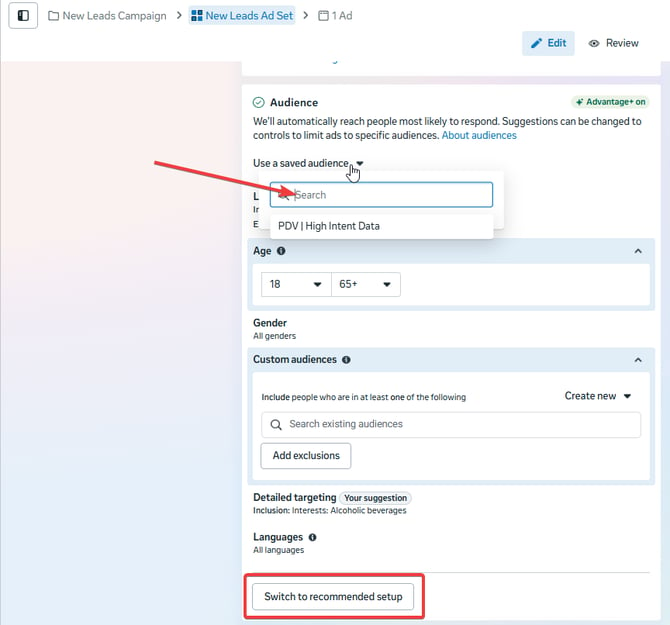
Some advertisers choose to disable broad expansion features such as:
-
Meta Advantage+
-
Google Performance Max
These features may allow platforms to serve ads beyond the selected Pearl Diver Intent audience. Depending on campaign goals and settings, this can increase reach but may also introduce traffic that is less aligned with the intended audience.
Geo-Targeting
You should continue to use any Geotargetting restrictions in your campaigns in your advertising platform. This means if you accidentally leave Advantage+ on, for example, then at least the suggested contacts will be within your targeted area.
Demographic Targeting
You should continue to use any demographic restrictions in your campaigns in your advertising platform. This means if you accidentally leave Advantage+ on, for example, then at least the suggested contacts will be within your targeted range.
Ad Placement Settings
It can be helpful to review placement performance regularly to understand where ads are appearing and how those placements are performing.
In some cases, certain placements may generate clicks without meaningful engagement. For example:
-
Short-form video placements may sometimes lead to accidental clicks when users interact with on-screen elements.
-
These clicks can result in brief visits and limited on-site activity.
Metrics such as average session duration and conversion rate by placement can provide additional context when reviewing results.
Reviewing Low-Quality or Off-Target Leads
If conversion performance appears lower than expected, some areas that teams often review include:
-
Landing page average session duration
Short sessions may indicate a mismatch between ad messaging and landing page content or indicate the clicks are accidental. -
Visitor location data
Checking whether traffic aligns with the intended geographic and customer profile. -
Ad platform reporting
Reviewing which placements, creatives, or segments are driving clicks relative to conversions.
Consider Revising Creative
As leads begin to come through, some advertisers notice through follow-up or engagement that a portion of those leads may not be well-qualified (for example, they may not meet budget or readiness expectations).
One approach some teams explore is adjusting ad creative to set clearer expectations upfront. This can help encourage self-selection before a user submits a form or makes contact.
For example, messaging that references pricing ranges, minimum requirements, or readiness criteria (such as “Have $100k already saved for a home loan?”) may help filter out prospects who are less likely to be a good fit.
As with other elements of a campaign, changes to creative can be tested and reviewed over time to understand how they impact lead volume and quality.
As the algorithms test multiple creative types and variations to determine what engages leads most, it’s best practice to include a wide range of creative in your campaign for optimal performance.
Budget & Learning Period
Advertising platforms typically go through a learning phase when a new campaign is launched.
Some advertisers observe that this period can last around two weeks, depending on daily spend and conversion volume (typically with budgets over $50 per day). Once learning stabilizes, performance data may better reflect the campaign’s longer-term potential.
Frequent structural changes during this phase will reset the learning period.